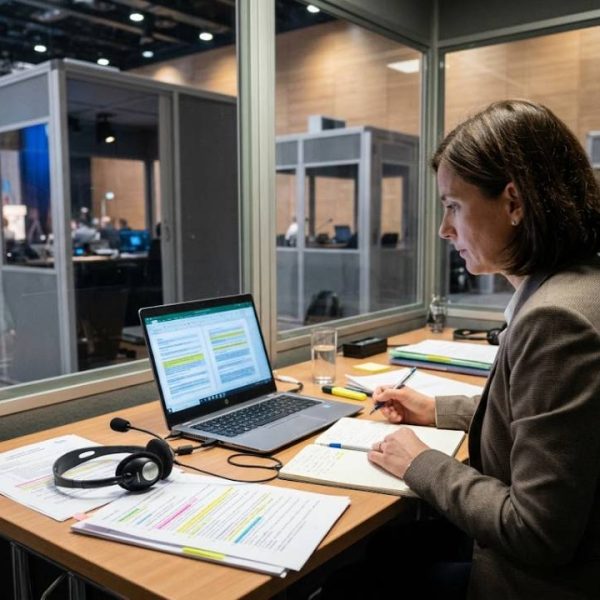
Interpreters and translators share languages but rarely share tools. Translators sit in front of a screen, working through documents sentence by sentence. Interpreters work live, in hospitals, courtrooms, booths and video calls, with no time to look anything up. So why are more and more interpreters opening translation software before an assignment?
The answer is preparation. The quality of an interpretation is often decided days before the session, when the interpreter builds the terminology they will need. Computer-assisted translation software turns out to be very good at exactly that.
A short explanation of CAT software
Many interpreters first type "what is cat tool" into a search engine after hearing translator colleagues mention it. In simple terms, computer-assisted translation software helps a human translator work with a document. It splits the text into segments, stores every translated sentence in a memory for reuse, keeps approved terms in a termbase and runs checks for consistency and missing numbers.
It is not machine translation. The human remains the author of every sentence. The software organises, remembers and checks.
Termbases as an interpreter's glossary
For interpreters, the most useful feature is the termbase. Instead of a loose spreadsheet or handwritten list, a termbase stores each concept with its equivalents in several languages, definitions, context sentences, notes on usage and even pronunciation hints. Entries can be filtered by client, subject or event.
A medical interpreter preparing for an oncology clinic can maintain one growing termbase for oncology terms, adding new drugs and procedures over time. Before each session, a filtered list for that specialty gives a clean, searchable reference.
Extracting terms from documents
Event organisers often send speeches, slides, agendas and background papers in advance. Translation software can extract candidate terms from these documents automatically, listing frequent multi-word expressions that are likely to be technical vocabulary. The interpreter reviews the list, adds equivalents and discards noise.
That saves hours compared with reading everything and highlighting by hand, and it surfaces specialised terms that are easy to overlook on a first read.
The same preparation discipline applies to research settings, where an interpreted interview can become a study's primary evidence. Projects that bring in interpreting services for multilingual fieldwork benefit from interpreters who prepare glossaries from the research protocol and pilot interviews. Terms agreed with the research team before fieldwork begins keep questioning consistent across participants. When the interpreted sessions are recorded and transcribed, researchers can quote and analyse the material with confidence that the wording reflects what participants actually said.
Aligning past documents
Many clients already have bilingual documents: previous reports, contracts or presentations in both languages. Alignment features pair up the sentences of an original and its translation, creating a bilingual reference corpus. Interpreters can then search how a particular term or phrase has been rendered before, which helps them match the client's established language.
Legal and court settings
Court and legal interpreters face specialised vocabulary that differs between jurisdictions. Building a termbase from case documents, statutes and procedural forms prepares them for terms that may come up in testimony or proceedings. Because interpreting in these settings is a recognised discipline with high stakes, as outlined in this overview of language interpretation, thorough preparation is part of professional practice.
Sign language and remote interpreting
Sign language interpreters also prepare terminology, particularly for technical or academic assignments where agreed signs for specialised concepts may need to be discussed in advance with the deaf client. A shared termbase can record agreed glosses and notes, which helps when a team of interpreters rotates on a long event.
For remote interpreting, where interpreters may join at short notice, shared online termbases mean that any team member can access the same prepared vocabulary instantly.
Working as a team
Interpreters rarely work alone on large assignments. Conference teams, hospital interpreting pools and court rosters all benefit from shared terminology. Browser-based translation platforms let several interpreters contribute to one termbase, comment on entries and see updates in real time. The result is consistent terminology across the whole team, which listeners notice even if they never know why.
From termbase to booth sheet
On the day of the assignment, a long termbase is too much to scan. Most interpreters export a short, filtered list of the twenty to fifty terms most likely to come up, sorted by topic or by agenda item. Some print it, others keep it on a tablet. Either way, the source is the same organised database, so nothing gets lost between preparation and performance. After the session, any new terms heard in the room go straight back into the termbase for next time.
Keeping it practical
Interpreters do not need every feature translators use. Memory statistics, file filters and complex workflows matter less. What matters is a fast, searchable termbase, easy term extraction, simple sharing and export to a format that can be printed or opened on a tablet in the booth. Many interpreters start with a free or low-cost plan and expand only if they find themselves relying on it daily.
Where the two professions meet
Agencies that offer both translation and interpreting have an extra advantage. Terminology approved for a client's written documents can feed directly into interpreter briefings, and terms that come up in live sessions can be added back for translators. Spoken and written communication stay aligned.
Better prepared, more confident
Good interpreters have always prepared carefully. Translation software simply gives that preparation a better structure. Organised termbases, searchable reference texts and shared team resources help interpreters arrive at each assignment confident that the right words will be there when they need them.